
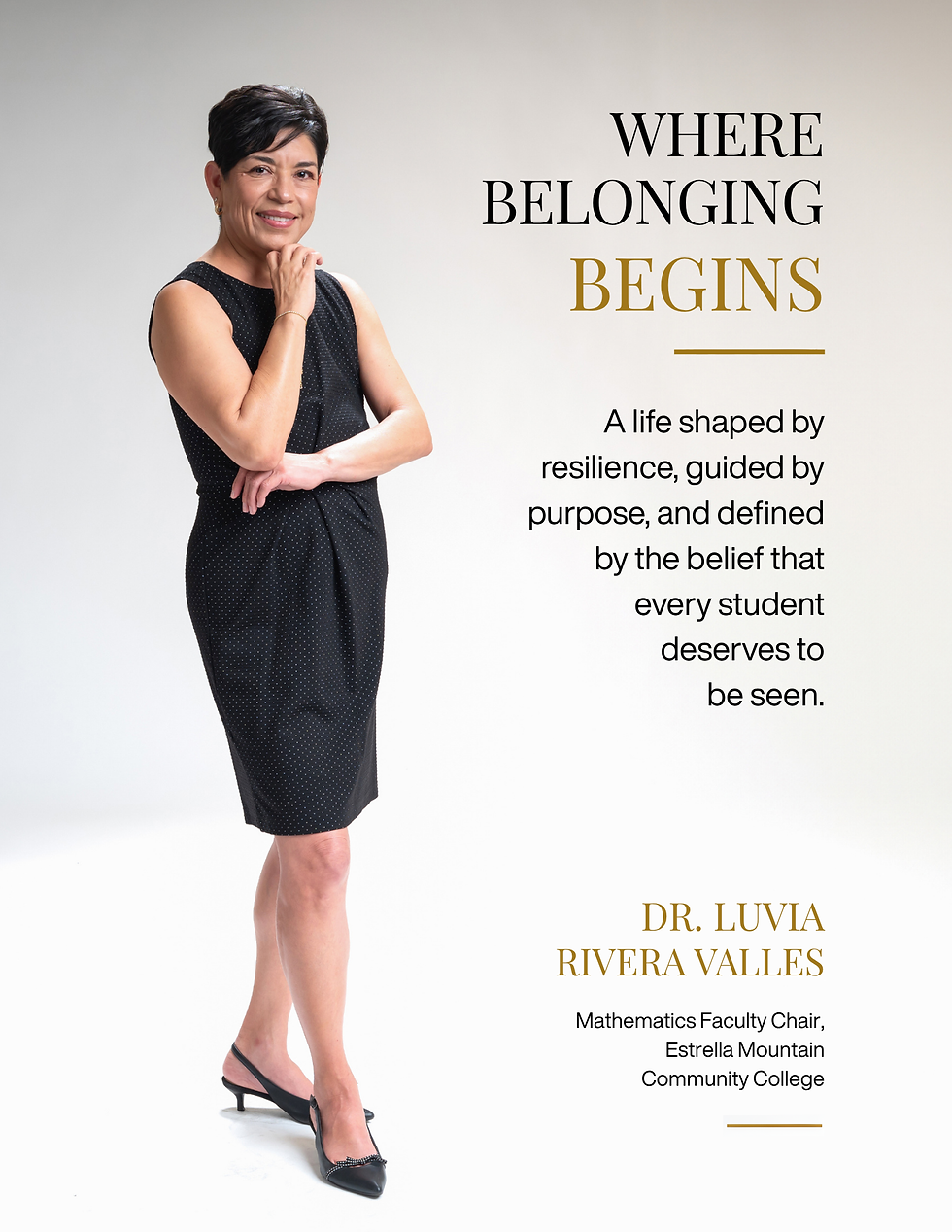
Dr. Luvia Rivera Valles
Where Belonging Begins
The Girl Translating the World
Long before Dr. Luvia Rivera Valles became a respected mathematics educator, department leader, mentor, and advocate for student belonging, she was a little girl sitting beside her mother in waiting rooms, grocery stores, and bank lobbies, helping her family navigate a world they were still learning to understand.
Her parents immigrated to the United States in search of opportunity and stability.
Her father worked as a migrant laborer before eventually finding work at a Catholic parish, where he later helped bring the rest of the family to Arizona.
Her mother cleaned houses while raising eight children, building a life through sacrifice, determination, and faith.
Luvia remembers accompanying her mother to clients’ homes because she was one of the few family members who could speak English.
“I became the person who explained things,” she recalls. “Even as a child, I understood that my family depended on me.”
At an age when most children are still discovering themselves, she was already learning responsibility, resilience, and how to move between two worlds.
Those experiences would shape nearly every part of the woman she would become.
Feeling Behind
As a child, Luvia was placed in ESL classes because English was not her first language. Yet even then, she loved learning. She especially loved reading.
In third grade, she entered a school reading competition and won.
“That changed something in me,” she says. “I realized I could do more than people expected.”
Still, the academic road ahead was not easy.
When she later transferred into a more academically rigorous Catholic school, the differences between her and many of her classmates became impossible to ignore. Many students arrived with stronger academic preparation and educational support at home. Luvia and her siblings did not have that luxury.
Her parents could not help with homework because they themselves were navigating language barriers and unfamiliar systems.
“I remember feeling very behind,” she says. “Not because I wasn’t capable, but because there were so many things I hadn’t been exposed to yet.”
What changed her journey were teachers who saw potential where others saw limitations.
During the summers, several educators volunteered to tutor Luvia, her sister, and her brother, helping them catch up academically and regain confidence.
Looking back, she still speaks about those teachers with deep gratitude. “They changed my life,” she says simply.
The Moment Everything Clicked
By seventh grade, something unexpected happened.
Mathematics suddenly made sense.
While other subjects often required constant catching up, pre-algebra and algebra felt natural to her in a way she had never experienced before.
“It just clicked,” she recalls. “For the first time, I wasn’t struggling to understand.”
Soon, classmates began asking her for help. And that became the real turning point.
For years, Luvia had quietly carried the feeling that she was behind everyone else academically. But now, she was the one explaining concepts to others.
“That gave me confidence,” she says.
“I realized I wasn’t just understanding it, I could teach it.” Without realizing it, she had already begun stepping into the role that would eventually define her life.
Learning to Advocate for Herself
Even as her abilities became increasingly evident, systems continued underestimating her.
Placement exams repeatedly placed her in lower-level courses despite the work she had already mastered. Rather than accepting those decisions, Luvia advocated for herself.
She asked teachers for permission to work ahead. She studied advanced material independently. She learned how to teach herself concepts long before she ever formally became an educator.
“I learned very early that one test score doesn’t define your potential,” she says.
That lesson would later become central to her teaching philosophy.
Today, she intentionally creates multiple ways for students to demonstrate learning because she understands firsthand how easily intelligence can be overlooked when people are measured too narrowly.
Discovering Belonging at ASU
One of the most pivotal moments of Luvia’s life came through the Math and Science Honors Program at Arizona State University.
For the first time, she found herself on a university campus surrounded by students who looked like her, shared similar backgrounds, and dreamed of futures they had not always been encouraged to imagine.
“I had never really seen myself at a university before,” she says. “That program opened the door.”
Even after being placed in the lowest math course in the program, she remained determined. She earned an A, returned the following summer, and enrolled in Calculus.
More importantly, she discovered something she had not fully experienced before:
Belonging.
The friendships she formed there would last decades. The mentors she encountered would permanently alter the trajectory of her life.
One of those mentors was Dr. Joaquin Bustoz. After Luvia earned a 3.8 GPA during her first semester of college, he called her into his office and asked about her major. When she shared that she was considering bilingual education, he responded with certainty:
“You’re going to be a math major.”
The words stayed with her. “Until then, I don’t think I fully believed I was capable of that,” she says.
But he did. And slowly, she began believing it too.
Purdue, Teaching, and Finding Her Calling
Luvia’s academic journey eventually led her to Purdue University, where she pursued graduate studies while teaching mathematics courses as a teaching assistant.
That experience changed everything. For the first time, she understood that teaching was not simply something she enjoyed; it was who she was.
“I loved helping students understand something they thought they couldn’t do,” she says.
She introduced multiple ways to solve mathematical problems because she wanted students to think critically rather than memorize procedures. More importantly, she wanted students to feel safe asking questions and struggling openly.
She understood what it felt like to doubt yourself in a classroom. And she never wanted her students to feel invisible.
Resilience Beyond the Classroom
While building her academic and professional career, Luvia was simultaneously fighting battles that few people around her fully understood.
After the birth of her first child, she became seriously ill. Years later, during her second pregnancy, her health rapidly deteriorated. She eventually lost both kidneys and began dialysis while pregnant.
Her daughter, Iliana, was born prematurely at just one pound and eight ounces.
Today, Iliana is 28 years old. “She is one of my greatest joys,” Luvia says.
Her journey would continue through kidney transplants, years of medical challenges, dialysis, and eventually a breast cancer diagnosis that was caught early and successfully treated.
Yet even as she describes these moments, she does not speak from a place of bitterness.
Instead, she speaks about gratitude. About perspective.
About learning how deeply precious life becomes after surviving its hardest chapters.
“I don’t share those experiences for sympathy,” she says. “They’re simply part of who I am.”
And perhaps part of why she understands so deeply what it means to persevere.
Creating Spaces Where Students Feel Seen
Today, as Mathematics Faculty Chair at Estrella Mountain Community College, Dr. Valles-Rivera leads with both expertise and humanity.
Her recently completed doctorate focused on one concept she believes can change the trajectory of a student’s life:
Belonging.
Before students can succeed academically, she believes they must first feel safe enough to believe they belong in the room.
“In my classroom, students know they matter,” she says.
She learns their names. She notices when they stop showing up. She creates space for different voices and experiences. Because she remembers exactly what it felt like to question whether she belonged. And she knows how life-changing it can be when someone helps you believe that you do.
The Legacy She Hopes to Leave Behind

Ask Dr. Rivera Valles what success means to her today, and she will not talk about titles, accolades, or accomplishments.
She talks about students.
The ones who nearly gave up but stayed. The ones who discovered confidence they did not know they possessed. The ones who now mentor others because someone once mentored them.
“It’s a chain of belief,” she says. “Passed forward.”
That belief transformed her life. Now she spends hers passing it on.
And if there is one message she hopes the next generation carries with them, it is this:
Do not allow circumstances, systems, or other people’s limitations to determine what is possible for your life. Keep going. Keep learning. Keep asking questions.
Because sometimes the most important thing a person can hear is simply this:
You belong here.


Comments